A Market Full of Products, Yet Starved of Adoption
On market saturation, solo therapists, and why I chose to bootstrap HearMeNow
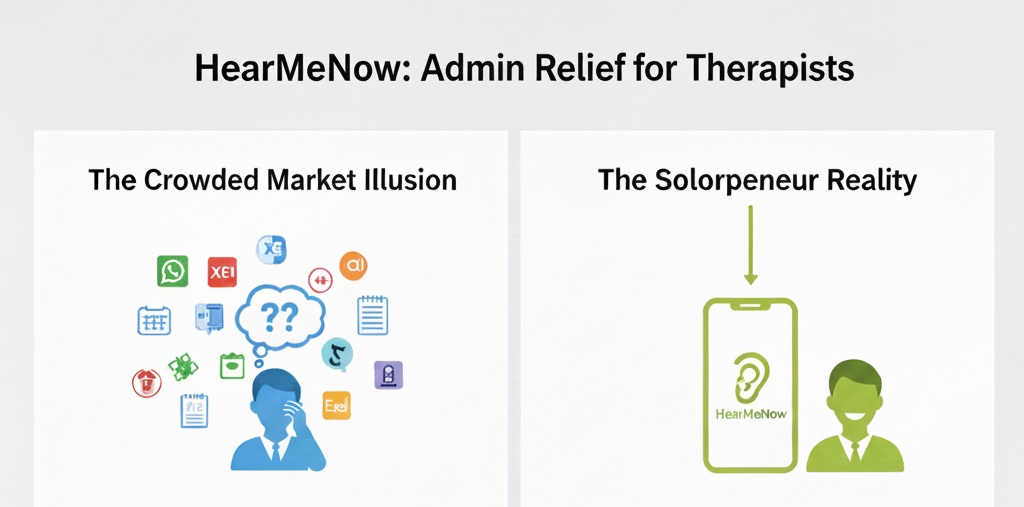
Since I started building HearMeNow, I have spoken to many people. Firstly, I have spoken to several therapists who have opened their working lives to me and provided the real insight into their needs and everyday frictions of solo therapist admin. However, this article is not about them. This article is about the conversations I have had with some other people in the journey. I had spoken with a guy from my B-school incubator, I had spoken to a CEO of a tech company, I had spoken to an engineer friend and few other people in the tech space. Everyone asked me these two questions:
- The market is saturated, what makes your product differentiated.
- Why are you not raising funds
I am in the “quiet middle” where all the heavy thinking about product specs and app architecture are done and the developers are building my idea. Since my mind seems to be occupied with rather catastrophic thoughts about the future of HearMeNow, I thought this is an opportunity for me to ruminate on these questions and answer them with intellectual honesty.
Is the market truly saturated?
Whether the market is saturated or not is a matter of perspective. From my vantage, I do not think the market is saturated. It is definitely true that there are a plethora of apps and platforms that claim to reduce admin, or provide “AI for therapists”. There are also several AI transcription apps on the App Store or Google Play. However, if the market were to be truly saturated, then the majority of therapists must be using digital tools, they often feel locked in, switching is painful and their default workflow is digital.
However, this was not what I found in my research involving over 80 UK-based therapists. Most were still managing their admin the old-fashioned way- text message, WhatsApp, emails, pen & paper, manual diary, word or excel documents to store notes. Even those who used digital tools found the tools fragmented in some way. This got me thinking to my own life as an NHS clinician. I use electronic medical records routinely, but some days I feel my life would be way better without these electronic medical records. The reason is simple, most of these platforms are built with a compliance-first principle. They are rarely built with a clinician-first or user-first principle.
So, to someone who is used to being pitched products, or someone who is looking at the market from the perspective of the available products (product-centric lens), the market is clearly saturated. However, to someone like me who is looking at the market through the lens of the end user (user-centric), this market is actually a very immature market. Don’t get me wrong, I am not saying this is an easy market to crack. It is probably the most difficult niches to crack- it’s a high trust, low adoption niche. Effectively, it is a market that is crowded with attempts, but thin in real behavioural changes.
What differentiates HearMeNow?
Having answered the first part of the question, let me answer the 2nd part of the question. What differentiates HearMeNow from the other tools in the market? Initially, my thought was that its biggest differentiator is that it is specifically designed for the solo therapist. But a deeper analysis shows that while it can be a positioning wedge, this approach can’t be a true differentiator. Most of the tools available in the market are built for VC scale buyers, group practices/clinics or enterprise NHS or IAPT type organisations. Solo therapists are often an afterthought. So, designing a system from ground up for a sole therapist is a sound market segmentation strategy. However, this by itself can’t be a sound differentiation strategy.
Let’s assume a scene where I say to a solo therapist- this tool is built specifically for you. Most therapists would say to me- “so are half the tools I’ve seen” or “everyone claims to be focused on my needs”. Differentiation will only work if I can answer this critical question- “what can a therapist do with HearMeNow that they can’t realistically do with other tools or tools that they currently use?”
So, who is HearMeNow built for and what does it do?
HearMeNow is built for “one user”, “one workflow”, “one clinical brain”. It has no committees, supervisors or multilayer permissions. HearMeNow explicitly aims to remove invisible work that often creeps into the evenings and weekends. It does not require a 3-week migration or need to import or export from existing systems. HearMeNow has been designed with a minimalistic architecture- both in terms of data and infrastructure. Essentially, it is structurally aligned with solo therapist admin reality. The ideal customer of HearMeNow is a solo therapist who is time-poor, ethically cautious, and non-tech-enthusiast. They with no admin staff, no IT department, and no cognitive bandwidth. HearMeNow does not aim to be feature rich, it exists to delete friction.
The above is a powerful market differentiator. But it is still not a sharp enough sales differentiator, unless it reduces setup, reduces cognitive load, reduces data risk, reduces time waste and reduces admin surface area. This is where the real uniqueness of HearMeNow will lie!
Why I choose to bootstrap HearMeNow?
Now, let’s move to the 2nd question. I am bootstrapping this venture without access to any VC funding. And this is a conscious choice. And the answer to this question goes to the heart of why I am building HearMeNow. I have lived the life of a clinician and know what admin friction does to one’s peace. I know what burnout feels like for a clinician. This is a domain that I am deeply invested in. And this is not a domain that can be hacked with viral marketing or social capital. Accessing VC funding is only going to force me to scale in an unsustainable and possibly unethical manner. This goes against every moral fibre in my brain.
There have been days when I have wondered if I should be building a consumer product as this niche is so difficult. However, I am building HearMeNow because it’s a problem that actually bothers me, in a group that I respect, in a system that I know is broken from inside and in a domain where “quick wins” are usually shallow or unethical! The above combinations automatically disqualify me from viral dynamics and burn-fast, scale-fast model of VC funded startups.
And if I had to do it again, I would still choose the bootstrapped model as this model has instilled a great degree of financial discipline. Because my capital is limited, I can’t afford to overengineer or stuff features into HearMeNow. It has forced me to be brutally honest about the problem I wish to solve. And most importantly, it has forced me to listen to my customers and understand their needs fully.
Conslusion
Despite all the above, it is very much possible that no therapist may want to pay for HearMeNow. And the only way to know if HearMeNow solves a pain point for therapists is to pitch the product to them. Only users get to judge value, everything else is commentary. If it is proven that therapists won’t pay for HearMeNow, I must graciously accept their verdict.
I am Dr Sriram Ravichandran, a consultant haematologist and an EMBA student. I write on various issues that affect therapists, mostly about therapist burnout.